3 September 2026・Field Note 02
What to Leave in Your Yard This Fall:
6 small ways to help birds and pollinators
There comes a point each fall when the yard seems to ask for a cleanup.
The flowers that looked generous a few weeks ago are beginning to brown. Seedheads lean over the path. Leaves gather beneath the shrubs. A few stems have lost their color completely. It is easy to stand there with the pruners in hand and see a list of jobs: cut this back, rake that up, make everything neat before winter.
But it can be worth looking at once more before you start.
Gardens have a way of looking finished before they actually are.
A dried flower may still hold seeds for a visiting bird. Berries can remain useful long after the leaves around them have changed. One of the last flowers in the bed may still be offering nectar and pollen. Beneath fallen leaves, or among stems that seem past their usefulness, small forms of life may already be settling in for the colder months.
None of this means a yard has to be left entirely alone. Paths still need clearing. Diseased plants may need attention. Leaves do not have to stay wherever they happen to fall.
The idea is simpler than that: fall cleanup can be selective.
If you are already thinking about the broader ways an ordinary yard can support birds, our first Field Note explores seven small ways to make your yard more bird-friendly. This time, we are looking at what happens when summer begins to leave—and why a few things may be worth leaving with it.
1. Let Some Flowers Go to Seed
Deadheading is such a familiar garden habit that it can become almost automatic. A flower fades, the stem looks tired, and off it comes.
By fall, though, some of those spent flowers have moved into another stage.
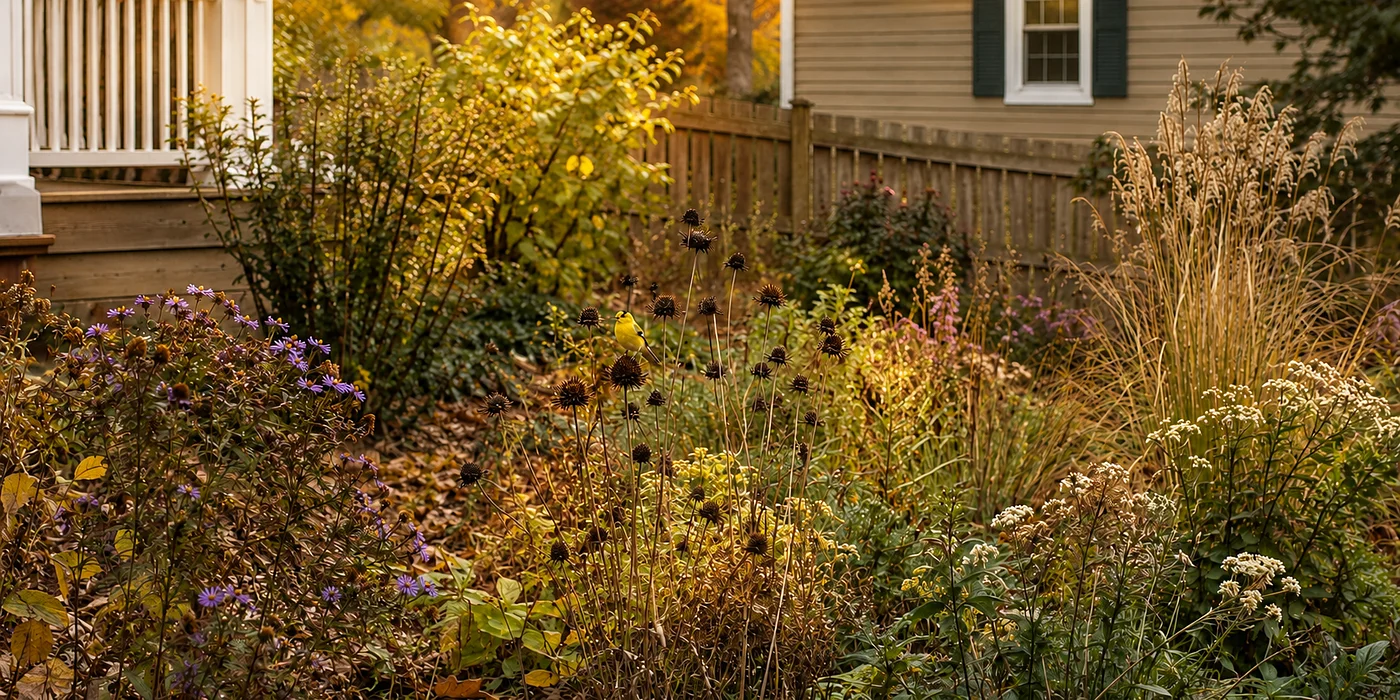
Coneflowers, asters, sunflowers and other seed-producing plants can hold food for seed-eating birds after flowering has ended. The National Wildlife Federation notes that dried flower heads and other seed-bearing plants can be used by birds such as goldfinches and juncos, while the remaining stalks also add cover and structure to a winter garden.
You may notice this most clearly when a goldfinch lands on a stem that looked, from the kitchen window, as though it had nothing left to offer. The plant bends under the bird’s weight. A few seeds disappear. Suddenly the untidy part of the border looks a little different.
That does not mean every spent flower needs to remain standing. Not every seedhead is equally useful, and different birds use different plants.
Instead, consider choosing a few sturdy, seed-rich plants and leaving them alone for a while longer. You can still trim what flops across a path or remove plants that genuinely need attention.
A garden does not have to choose between tidy and wild. Sometimes a few standing seedheads are enough to make room for both.
2. Leave the Berries Where Birds Can Find Them
Flowers tend to get most of the attention in a wildlife-friendly yard, but some of the garden’s most helpful autumn color arrives later.
Depending on where you live, berries on dogwoods, hollies, viburnums, junipers and other shrubs can become seasonal food for birds as insect availability changes and the growing season winds down.
The National Wildlife Federation notes that many birds use berries and seeds in late summer and fall, including species that spend much of the warmer season eating insects. And Audubon’s guidance on berry-bearing native plants points out that some native shrubs hold fruit well into winter, extending their usefulness beyond the obvious garden season.
So if a healthy shrub is carrying berries, there is usually no reason to prune them away simply because fall has arrived.
The more important question is which shrub.
A plant described as “good for birds” is not automatically a good choice everywhere. Native ranges differ widely across the United States, and some berry-producing plants that birds eat are invasive. Even among native shrubs, some species have separate male and female plants and need appropriate companions nearby to produce fruit.
For future planting, the better approach is to look for berry-producing species that belong naturally in your region and suit the light, soil and moisture conditions in your yard.
For now, if you already have the right plant in the right place, its autumn berries may be worth enjoying exactly where they are.
3. Give the Late Flowers Their Time
A garden in September can contain two seasons at once.
One part of the bed may already be brown and full of seed. A few feet away, another plant may still be blooming as though summer has not quite finished.
Those last flowers are easy to overlook when our attention has shifted toward fall cleanup. But for pollinators still active in the landscape, late-season flowers can remain useful sources of nectar and pollen.
The Xerces Society recommends providing a succession of flowers from spring into fall because different pollinators are active at different points in the growing season. Xerces notes that late-summer flowers can provide resources for newly produced bumblebee queens preparing to overwinter.
That makes one of the easiest fall garden decisions especially simple:
If a healthy plant is still flowering, let it finish.
You do not need to rush the garden into winter simply because the calendar says September or October.
Plants such as asters and goldenrods are familiar examples of late bloomers in parts of the country, but they should not be treated as a universal planting prescription. The best choices depend on where you live.
What matters is the pattern: a yard with something flowering late can extend the season for insects that are still out searching.
There is something quietly satisfying about that last patch of bloom. Summer may be receding everywhere else, but one corner of the yard is still open for business.
4. Keep a Few Stems Through Winter
Of all the things we remove in fall, bare stems may be the easiest to dismiss.
Once the flowers and leaves are gone, a dried perennial stalk can seem to have no purpose except to remind us that the garden needs cutting back.
But stems add something less visible than color.
Some insects use plant material, hollow stems, dead wood and other small natural spaces for nesting or overwintering. The Xerces Society’s guidance on nesting and overwintering habitat recommends incorporating natural features into landscapes because different native bees and beneficial insects use them in different ways.
This is also a place where a little precision matters.
It would be too simple to imagine that every brown stem has a bee sleeping inside it. Some insects may already be sheltering in or around dried vegetation, while certain pithy or hollow stems can become nesting sites for solitary bees when suitable openings are available. Different species have very different habits.
The practical lesson is not to inspect every stalk for occupants.
It is simply to leave some structure.
A few upright stems among grasses and seedheads can remain through winter without making the whole yard look abandoned. In fact, in low winter light, their shapes can give a garden a kind of spare beauty that disappears when everything is cut flat to the ground.
Sometimes the habitat value and the visual interest turn out to be the same thing.
5. Let Some Leaves Stay Close to the Soil
Fallen leaves create perhaps the biggest tension between a tidy yard and a living one.
They drift over the lawn. They collect against steps. They blow into paths. On some properties, leaving every leaf exactly where it lands would be neither practical nor particularly helpful.
Fortunately, helping wildlife does not mean every leaf has to stay exactly where it falls.
Leaves can be moved.
Instead of bagging each and every one, consider raking some into garden beds, beneath shrubs or into a quieter corner where they can remain closer to the soil.
The Xerces Society’s “Leave the Leaves” guidance explains that fallen leaves and other organic material provide insulation and overwintering habitat for a wide range of invertebrates. Caterpillars, chrysalises, bumblebee queens and many other small creatures spend the colder months in or beneath this ordinary layer of garden material.
That matters to birds, too. Many of the insects sheltering in and around a yard are also part of what birds come looking for.
The goal, again, is not to turn leaf litter into a rule.
A thick mat can be hard on turf. Leaves should not be allowed to block drains or make walkways unsafe. Around the base of shrubs and within planted beds, however, they can look entirely natural.
One of the easiest compromises is simply to move rather than remove.
Clear the front walk. Rake the lawn where necessary. Let a few leaves settle under the serviceberry or along the back edge of the perennial bed.
The yard can still look cared for.
It just does not have to look swept clean.
6. Leave Some of the Cleanup for Later
Once you begin looking at fall cleanup this way, the job changes slightly.
Instead of asking, “What can I finish today?” you begin asking, “What actually needs doing now?”
Some things can be dealt with immediately. Others can wait through winter. And some of the material left standing in autumn can be revisited gradually as the next growing season begins.
This staged approach is useful because wildlife does not work from one national gardening calendar. Different insects overwinter in different forms and emerge at different times. The Xerces Society’s current guidance on spring garden cleanup makes the point clear: there is no single date that works everywhere, because weather, region and species all affect when insects become active again.
That is why a universal rule such as “clean everything up when temperatures reach one particular number” is less useful than paying attention to local conditions and regional Extension guidance.
What Still Makes Sense to Clean Up
Selective restraint is not the same thing as ignoring problems.
If plants have had significant pest or disease issues, removing affected debris can be sensible; University of Illinois Extension specifically identifies diseased or pest-affected plant material as an exception to its wildlife-friendly fall cleanup guidance.
Invasive plants can be removed rather than preserved simply because they carry berries or seeds. Paths and entrances can be kept clear. Leaves belong out of streets and storm drains.
And regional safety guidance takes priority. In wildfire-prone areas, for example, CAL FIRE’s defensible-space guidance calls for removing dead and dry vegetation and accumulated leaves in specified areas around structures.
A wildlife-friendly yard still has to work as a home.
The useful distinction is between what needs to be removed and what we remove simply because the season has changed.
By the time the work is done, the yard can still look settled for fall.
The walkway is clear. Plants with problems have been dealt with. The tools can go back in the shed.
But perhaps the coneflowers still carry their dark seedheads. The shrub remains heavy with berries. A few stems catch the low afternoon light. Fallen leaves lie beneath the shrubs instead of inside a plastic bag.
None of it has to look neglected.
It can simply look like a garden that has been allowed to keep a few traces of the season.
And those traces may still be helpful long after we have stopped thinking of the yard as active: a seed taken by a goldfinch on a cold morning, a small insect protected beneath leaves, a stem waiting quietly through winter.
There is a particular pleasure in discovering that making a yard more hospitable does not always require another project.
Sometimes making more room for life is less about adding something new than knowing what not to remove yet.